Canadian Mortgages, Insurance, Investment, Tax Planning

Newsroom

Revenu Québec - Tax News

XE Forex News

Canadian Mortgage Broker news

Friday, April 24, 2015

The Money Management Newsletter - Bulletin

The Money Management Newsletter - Bulletin


How to fix RRSP overcontributions
By Jessica Bruno, December 5, 2014
Why read this?
  • You have an RRSP
  • You’ve exceeded your contribution limit
What’s an overcontribution?

If you have undeducted RRSP contributions exceeding your deduction limit by more than $2,000, you’ve overcontributed.

What to do

STEP ONE: Decide whether or not to withdraw the money.

Canada Revenue Agency (CRA) may penalize overcontributions above the $2,000 cushion by 1% of the excess amount per month, but you aren’t obligated to withdraw the money, says Sandy Kirkwood-Pearce, owner and president of Sleegers Kirkwood-Pearce. “If the investment is doing really well, the consequences of the overpayment penalty […] might be overshadowed,” she says.

STEP TWO: If you decide to remove the money, ask CRA to waive withholding tax.

  1. Use Part 1 of Form T3012A Tax Deduction Waiver on the Refund of your Unused RRSP, PRPP, SPP, or RRIF Contributions made in ___ (year) to calculate the amount the RRSP administrator can refund without withholding tax.
  2. Under Part 2, designate which RRSP to withdraw the money from, and a destination account.
  3. Attach proof of the overcontributions, such as certified copies of receipts, and send four copies of the form to CRA.
  4. If CRA approves, it will return three signed copies of the form.
  5. Send the copies to your financial institution.
  6. Once the withdrawal is done, the institution will return two copies.
TIP: Filling out the T3012 may not be worth the time, or the accountant’s fees, if there’s little tax to be withheld, says Karen Slezak, a tax partner at Crowe Soberman LLP. “Withdraw the overcontribution and don’t worry that there will be some withholding tax,” she says. The tax withheld will count toward your annual tax return. Take the money out in batches under $5,000 to minimize withholding tax, Slezak adds.

STEP THREE: Ask CRA to waive the 1% monthly excess contribution tax.

- CRA may approve your request, if:

  1. your excess contributions arose due to a reasonable error; and
  2. you’re withdrawing, or have withdrawn, the excess contributions.
- To make a request fill out Form RC4288 Request for Taxpayer Relief – Cancel or Waive Penalties or Interest or write to CRA explaining:

i. why the error was made, and why it’s reasonable; and

ii. any steps you’ve taken to eliminate the excess contributions. Include copies of supporting documents, such as RRSP statements, that show you have withdrawn the excess funds, and any correspondence related to the error.

STEP FOUR: If CRA assesses the unused contribution room as a negative amount, you received gift money in your RRSP or you contributed money to your partner’s RRSP without claiming a tax deduction, you may have to submit Form T1-OVP Individual Tax Return for RRSP Excess Contributions.

  1. Determine whether you should submit the form with CRA’s T1-OVP quiz.
  2. If necessary, complete Form T1-OVP.
  3. Send CRA the form and outstanding tax.
WARNING: Payment is due 90 days after the end of the tax year. Starting on day 91, CRA charges compound daily interest on unpaid tax or penalties, a late filing penalty of 5% of the balance owing, and 1% of the balance for every month a return is late.

STEP 5: Complete your annual return.

  • If you paid withholding tax:
    • Fill out form T746 Calculating Your Deduction for Refund of Unused RRSP Contributions.
i. Enter the amount on Line 11 of the T746 on Line 232 of the return.

TIP: Complete a separate T476 for each year of overcontributions.

  • Write the amount in Box 20 of your T4RSP Statement of RRSP Income slip on Line 129 of the return.
  • Submit the T746 and T4RSP with your return.
  • If you didn’t pay withholding tax and have already filed the T1-OVP, complete your return as usual, says Kirkwood-Pearce.

Tuesday, March 3, 2015

Revenu Québec souhaite économiser 5 millions $ en papier

Revenu Québec souhaite économiser 5 millions $ en papier


mpôtNet

Revenu Québec souhaite économiser 5 millions $ en papier

Première publication 19 janvier 2015 à 12h06
Revenu Québec souhaite économiser 5 millions $ en papier
Crédit photo : capture d'écran, Revenu Québec
Agence QMI
Le code d'accès ImpôtNet Québec, qui permet de transmettre électroniquement une déclaration de revenus, sera remplacé pour la déclaration de 2015. La prochaine période des déclarations de revenus sera donc la dernière à connaître des envois massifs de codes sur papier.
À compter de janvier 2016, un nouvel authentifiant simplifié sera intégré directement aux logiciels autorisés. De cette manière, Revenu Québec n'aura plus à expédier les codes d'accès, le code de téléchargement et le bordereau de paiement personnalisé.
Cette nouvelle procédure permettra à Revenu Québec de réaliser des économies de papier considérables. Le nombre d'envois postaux et l'utilisation de papier s'en trouveront diminués de sorte que l'organisme estime éviter des dépenses de près de 5 millions $ par année.
Cette décision concerne les particuliers qui envoient eux-mêmes leurs déclarations par Internet et les préparateurs accrédités, qui préparent les déclarations de revenus pour le compte d'une autre personne, pour autant qu'ils utilisent un logiciel autorisé par Revenu Québec.

Un virage graduel

Pour la déclaration 2014, seuls les contribuables qui ont déjà adopté la transmission électronique recevront leur code d'accès. Ceux qui ont fait appel à un préparateur accrédité ou qui ont produit leurs déclarations sans l'aide d'un logiciel ne recevront pas ces envois postaux.
Les particuliers qui souhaiteront adopter la transmission électronique pourront toujours le faire. Pour obtenir leur code d'accès, il leur sera possible d'obtenir leur code en ligne, grâce au service Info-code de Revenu Québec ou dans l'espace «Mon dossier» ou encore par téléphone. Il sera aussi possible d'imprimer un bordereau de paiement personnalisé.

Monday, February 23, 2015

What happens to RRSPs in bankruptcy? | Advisor.ca

What happens to RRSPs in bankruptcy? | Advisor.ca


Your client just told you they declared bankruptcy. What will happen to their registered investment accounts?
The protection provided under Canadian law for registered investment products varies by type of account and insolvency proceeding. Here, we’ll focus primarily on Ontario.
RRSPs and personal bankruptcy
All provinces protect pensions well. For example, the Insurance Act of Ontario states that if thehas a life insurance component, it is exempt from seizure if the beneficiary is your client’s grandparent, parent, spouse, child or grandchild. This includes plans made up of segregated funds.
Prior to 2009, if the beneficiary was the debtor’s estate, these funds would have been at risk. But that year, the federal government changed insolvency laws to provide further protection for RRSPs. Funds that have been on deposit for longer than 12 months are now protected. However, funds that aren’t otherwise protected by the Insurance Act can be seized if they were deposited in the 12 months immediately before your client declared bankruptcy.
If your client has made contributions to an RRSP in the previous 12 months that are now at risk of seizure, he must either:
  1. request that his bankruptcy trustee arrange for these contributions to be withdrawn. The trustee will be responsible for paying any taxes owing as a result of that withdrawal prior to distribution to creditors; or
  2. pay the trustee the equivalent of the expected realizations (net of taxes) and leave their RRSP intact. Your client could pay this amount in installments over the term of their bankruptcy.
Unlike RRSPs, other registered accounts (such as RDSPs, RESPs and TFSAs) are not protected from seizure under Canada’s Bankruptcy and Insolvency Act. Any protection they may be entitled to are set out in each of the province’s Executions Acts. In most cases, a trustee is able to claim these assets for creditors (including Ontario). However, Alberta has recently made RESPs creditor-protected.
Recently, the federal government began its five-year review of the Bankruptcy and Insolvency Act. As part of that review, my firm submitted a request to Industry Canada for RESPs, RDSPs and other forms of registered investment products to be given the same level of protection as RRSPs. We’re hopeful they’ll correct this inequality.
Consumer proposals are different
A consumer proposal allows your client to negotiate a debt settlement agreement with their creditors, the main benefit being your client can keep their assets.
If your client files a consumer proposal, all assets remain in their possession, including TFSAs, RDSPs, RESPs and RRSP contributions from the previous 12 months.
What if your client has not yet declared bankruptcy, but is in financial trouble?
There are two kinds of debt: secured and unsecured. Secured debts have some form of collateral pledged as surety for the debt. If your client defaults, the lender has the right to sell the collateral. Fortunately, RRSPs can’t be used as collateral.
Any debt that’s not supported by collateral is unsecured. In a default, unsecured creditors have the right of set-off and recourse through the courts. The right of set-off allows a lender to take funds from one account to pay down a debt in another account. But it doesn’t apply to registered investment products. So if your client owes the bank for a loan, the bank cannot seize your client’s RRSP for repayment.
Recourse through the courts means the lender has the right to sue your client in order to recover the debt. If the lender’s lawsuit is successful, the court will issue a judgment, usually followed by a Writ of Execution or a Writ of Seizure. These writs allow a creditor to seize bank accounts, garnishee wages, and register a claim with the sheriff or bailiff. The writs don’t allow the creditor to seize RRSPs, but they may allow the seizure of other registered accounts such as RESPs and RDSPs.
Should your client find them self in financial distress due to unsecured debts, your client shouldn’t assume their best solution is to liquidate RRSPs and other investments that may be protected under the law. At the same time, your client may want to take action to protect any assets that their creditors can seize. Depending on your client’s situation, debt restructuring through a consumer proposal or perhaps an assignment in bankruptcy (i.e., using a trustee) may make more sense.
Ted Michalos is founder and trustee of Hoyes, Michalos & Associates.

Tuesday, February 10, 2015

Automobile allowance rates

Automobile allowance rates


Automobile allowance rates

The automobile allowance rates for 2015 are:
  • 55¢ per kilometre for the first 5,000 kilometres driven; and
  • 49¢ per kilometre driven after that.
In the Northwest Territories, Yukon, and Nunavut, there is an additional 4¢ per kilometre allowed for travel.
The automobile allowance rates for 2013 and 2014 are:
  • 54¢ per kilometre for the first 5,000 kilometres driven; and
  • 48¢ per kilometre driven after that.
In the Northwest Territories, Yukon, and Nunavut, there is an additional 4¢ per kilometre allowed for travel.
The automobile allowance rates for 2012 are:
  • 53¢ per kilometre for the first 5,000 kilometres driven; and
  • 47¢ per kilometre driven after that.
In the Northwest Territories, Yukon, and Nunavut, there is an additional 4¢ per kilometre allowed for travel.
The automobile allowance rates for 2010 and 2011 are:
  • 52¢ per kilometre for the first 5,000 kilometres driven; and
  • 46¢ per kilometre driven after that.
In the Northwest Territories, Yukon, and Nunavut, there is an additional 4¢ per kilometre allowed for travel.

Wednesday, January 21, 2015

Interest rate surprise: Bank of Canada drops key lending rate to 0.75 per cent | CTV News

Interest rate surprise: Bank of Canada drops key lending rate to 0.75 per cent | CTV News


OTTAWA -- The looming threat of sliding oil prices forced the Bank of Canada to drop its trend-setting interest rate Wednesday, a surprising move that shows just how much the country's economic outlook has soured in a matter of months.
The central bank, which nudged its key rate down to 0.75 per cent from one per cent, said the rapid oil-price collapse has created many unknowns around economic growth in the oil-exporting nation.
Until the effects of oil's late-2014 tailspin started to trickle through, Canada appeared to be on the cusp of a promising post-recession rebound -- and inching closer to a rate hike.
"The large decline in oil prices will weigh significantly on the Canadian economy," the Bank of Canada said in its quarterly monetary policy report, which it also released Wednesday.
"Given the speed and magnitude of the oil-price decline, there is substantial uncertainty around the likely level for oil prices and their impact on the economic outlook for Canada."
The loonie dropped after the announcement by 1.12 cents US to 81.48 cents US -- its lowest level since late April 2009, the last time the bank cut its overnight rate.
The decision Wednesday marked the first time the rate budged at all since September 2010 when the central bank raised it by a quarter point to one per cent.
The Bank of Canada was widely expected to once again stand pat on its rate Wednesday, with most economists projecting an increase in late 2015 or early 2016.
The central bank, however, predicts the impact of falling oil prices to overshadow encouraging signs of economic life spotted outside the weakening energy sector, such as rising foreign demand, a boost in exports and job growth.
"The oil-price shock is occurring against a backdrop of solid and more broadly based growth in Canada in recent quarters," the bank said.
"While business investment had been showing some encouraging signs in the third quarter of 2014, the near-term outlook appears much-less positive."
The bank also said the oil-price drop will have an adverse effect on income and wealth, which would reduce the growth of domestic demand. It also expected additional negatives on consumption and public finances.
The rate decrease aims to soften the blow of cheaper crude.
The Bank of Canada said lowering the rate was intended to "provide insurance" against risks posed by low oil to the country's inflation and its financial stability.
It predicted Canada's fortunes to also receive a boost from the ever-strengthening U.S. economy, an country expected to benefit from lower crude prices.
The bank's concerns over the oil slump come as some Canadian industries reel from the sharp plunge in crude prices, which are down more than 55 per cent since June.
The decline in oil prices is also expected to shave billions of dollars from the bottom lines of federal and provincial governments.
Last week, the federal government took the rare step of delaying the budget until at least April, so it could assess the effect of tumbling crude.
In November, federal Finance Minister Joe Oliver warned falling oil prices could cut $2.5 billion per year from the federal books between 2015 and 2019. Since that calculation, the price of crude has tumbled even further, from about US$80 per barrel to under US$50.
Experts believe the federal books for 2015-16 will come close to running another deficit, despite the Harper government's assertions it will deliver on its long-held vow to balance the budget.
An analysis Tuesday by the Conference Board of Canada predicted plummeting world oil prices to gnaw $4.3 billion from the Canadian government's 2015 income and deliver a nearly $10-billion hit to the provinces in royalties and tax revenue.
In the monetary policy report Wednesday, the central bank predicted the country's headline inflation rate to temporarily dip to one per cent -- below the bank's target range -- before climbing back up to two per cent in the second half of the year.
The central bank also highlighted persistent problems in Canada's labour market, where it found long-term unemployment was still close to its "post-crisis peak."
It said average hours worked remained low and the proportion of people who could only find part-time work was still high.
The bank predicted the pace of Canada's economic growth -- measured by the real gross domestic product -- to slow to roughly 1.5 per cent in the first half of 2015 and for the output gap to widen.
It projected the Canadian economy to gather steam in the second half of the year, allowing real GDP growth to average 2.1 per cent in 2015 and 2.4 per cent in 2016.
The bank's estimates were based on oil prices of US$60 per barrel, which is higher than current prices that are below US$50.
The report said if oil were to remain close to US$50, real GDP growth would dip to 1.25 per cent in the first half of 2015.
In its last monetary policy report -- in October -- the Bank of Canada predicted 2.4 per cent growth for 2015.
Since then, oil prices have dropped by more than 40 per cent.
In his October report, bank governor Stephen Poloz warned the extended period of an already-low interest rate of one per cent had propelled consumer spending to near-record-high housing prices and debt.
At the time, Poloz cautioned the low-rate environment had left Canadian households exposed to economic shocks.
On Wednesday, the bank reiterated the warning that Canada's indebted households remained vulnerable.
A fresh unknown -- the oil collapse -- has now been added to the mix.
"The precise magnitude of the impact of the fall in oil prices on household income, spending and, ultimately, on existing imbalances is highly uncertain," said the report, which still maintained its prediction of a soft landing for the housing market.
The Bank of Canada is scheduled to make its next interest-rate announcement March 4, while its next monetary policy report is due April 15.
The loonie's ups and downs over a 10-year period


Adjust date range using interactive slider

Sunday, January 4, 2015

What’s new for this tax-filing season?

What’s new for this tax-filing season?


Did you know?

You may be eligible for new or improved tax relief measures and online services when filing your 2014 income tax and benefit return.

Important facts

  • Children's fitness amount - Under proposed changes, the maximum amount of eligible fees for each child has increased to $1,000.
  • Search and rescue volunteer amount - As a search and rescue volunteer, you may be able to claim an amount of $3,000.
  • Family Tax Cut - A proposed non-refundable tax credit of up to $2,000 is available to eligible couples with children under the age of 18, and is effective starting with the 2014 tax year.
  • Universal Child Care Benefit (UCCB) - Under proposed changes, this benefit is being increased for children under age six. Effective January 1, 2015, parents will be eligible for a benefit of $160 per month for each eligible child under the age of six - up from $100 per month. Under proposed changes to expand the UCCB, parents may also receive a benefit of $60 per month for eligible children ages six through 17. Payments of the additional amount and expanded amount will start in July of 2015.
  • Emergency services volunteers - Rules for the $1,000 exemption for emergency services have changed.
  • Adoption expenses - The maximum amount of eligible expenses for each child has been increased to $15,000.
  • Medical expenses - Amounts paid as salary for designing of personalized therapy plans for persons eligible to claim the disability tax credit and costs for service animals used to help manage severe diabetes, are now eligible as medical expenses.
  • Investment tax credit - Eligibility for the mineral exploration tax credit has been extended to flow-through share agreements entered into before April 2015.
  • GST/HST credit - You no longer have to apply for the goods and services tax/harmonized sales tax (GST/HST) credit. When you file your return, the Canada Revenue Agency (CRA) will determine your eligibility and will advise those who are eligible to receive the credit. If you have a spouse or common-law partner, only one of you can receive the credit. The credit will be paid to the person whose return is assessed first. The amount will be the same, regardless of who (in the couple) receives it.
  • Online mail - When you register for online mail, you'll have instant access to your tax records anytime, anywhere. Choose to receive an email notification that your notice of assessment or reassessment is available online. Provide us with an email address on your T1 return or register directly online starting February 2015 atwww.cra.gc.ca/myaccount.
  • Mobile application: In February 2015, the CRA will be launching a mobile app for individual taxpayers.

CRA online services make filing easier and getting your refund faster

The CRA's online services are fast, easy, and secure. You can use them to file your income tax and benefit return, make a payment, track your refund, receive your notice of assessment, and more. Did you know that the Government of Canada is switching to direct deposit for all payments that it issues? This includes your tax refund and benefit payments. Sign up for direct deposit today! For more information, go to www.cra.gc.ca/getready.

Friday, February 14, 2014

Direct deposit

Direct deposit

The Government of Canada will increase the use of direct deposit by phasing out federal government cheques by April 2016.

Why choose direct deposit payments?
  • Convenient—Faster access to your money. There is no risk of your money being held up as a result of unforeseen delivery issues.
  • Reliable—Your payment will always be on time, and your money can begin to earn interest right away.
  • Secure—Direct deposit is fast, reliable and safe. There is virtually no risk of your payment being lost, stolen or damaged.
  • Low-cost—With fewer cheques to print and mail, we are saving Canadian taxpayers' money. The cost to produce a cheque is approximately 82 cents while a direct deposit payment costs about 13 cents.
Myths vs. facts about direct deposit
Myth: I'll always be able to get a cheque from the Government of Canada and have it mailed to me.
Fact: More and more Canadians are using direct deposit. The Government of Canada is committed to using taxpayer dollars wisely and increasing the use of direct deposit by phasing out cheques by April 2016. This transition will contribute significant savings through the reduction in the use of paper and related cheque-printing and delivery costs.
Myth: When I sign up for direct deposit and give my banking information, the Canada Revenue Agency (CRA) can also use this information to take any money I may owe from my bank account.
Fact: If you owe money to the CRA, giving your banking information will not trigger the process of withdrawing money from your bank account. When you register for direct deposit, you do not authorize the CRA to withdraw money from your bank account. When a taxpayer owes money to the CRA and must make payments, the CRA works with the taxpayer to come to an agreement. The CRA can only withdraw money from a taxpayer’s account when a garnishment is in place. A garnishment is a legal procedure to withdraw money from a bank account.
Myth: My banking information may not be safe if I sign up for direct deposit.
Fact: The CRA uses the same high levels of security that financial institutions use to protect your banking information. Go to Security for more information about security and the CRA.
Are you moving?
If you move, let us know your new address as soon as possible. Otherwise, your payments may stop, whether you receive them by cheque or direct deposit.
Are you changing your bank account information?
If you are changing any bank account held in Canada into which we deposit a payment, be sure to tell us about your new bank account. In addition, do not close the old bank account before we deposit the payment into the new bank account.
If your financial institution in Canada notifies us of a change in your banking information, we will deposit your payments into the new bank account.

Individuals

Only one form to fill out and you’re done! The Government will deposit all payments from different federal departments directly in your bank account.

Online

If you are registered for My Account, you can sign up for direct deposit now. If you are not yet registered, find out how using My Account can help you quickly and easily manage your tax affairs online.

By mail

Follow these two easy steps to sign up for direct deposit:

  1. Fill out the Direct Deposit Enrolment Form.
  2. Mail it to the address indicated on the form.

By phone

To sign up for direct deposit, or change your banking information, call 1-800-959-8281.

Video - Direct deposit for individuals:

Current position:00:00:00
Total time:--:--:--
Playback percentage:
Play full size version of the
video (1:00 min.)
| Alternative formats and transcript

Businesses

Follow these two easy steps to sign up for direct deposit:

  1. Fill out RC366, Direct Deposit Request for Businesses.
  2. Mail it to one of the tax centres.
For questions about direct deposit, call 1-800-959-5525.

Suppliers

Follow these two easy steps to sign up for direct deposit for accounts receivable:

  1. Fill out Form RC231, Vendor Electronic Payment Registration Request.
  2. Mail the form and a void cheque to the address on the form.

Thursday, February 6, 2014

FATCA deal finalized | Advisor.ca

FATCA deal finalized


Canada-U.S-flag


Canadian financial institutions won’t be required to report directly to American tax authorities, Finance Minister Jim Flaherty announced Wednesday.

Read: Who’s on the hook for FATCA?

Canada’s reached an agreement with the U.S. about FATCA. Canadian banks would report relevant information on accounts held by U.S. residents or citizens to CRA, which would share it with the IRS under existing tax treaty rules — making it consistent with Canadian privacy laws, said senior government officials.

Even better news is, Canadian financial institutions won’t have to report on accounts smaller than $50,000. It also exempts RRSPs, RDSPs, RESPs, RRIFs and TFSAs.

Today’s deal puts additional pressure on Americans living in Canada who, intentionally or not, haven’t been filing to the IRS, says Kevyn Nightingale, a tax expert at MNP LLP.

“The IRS has two main programs for people in these circumstances. The main one, which applies to the overwhelming majority of Americans in Canada, is called the streamlined approach. It requires three years of returns and six years of FBARs. There’s no guarantee there won’t be penalties, but it’s incredibly rare for the IRS to apply penalties to an American living in Canada using the streamlined approach.”

Today’s deal means the odds of showing up on IRS’ radar just rose dramatically for those who don’t make good with Uncle Sam.

“You know the information in your Canadian bank is going to be transmitted to the IRS. Up until now you’ve been able to believe that they’re not going to know about you. If you come forward there’s a good chance of having little or no penalties; if they find you, you can expect penalties. And they’re going to find people to make examples of.”

Nightingale adds that clients of investment advisors “are good targets. They don’t want a low-income single mother to make an example of.”

The Investment Industry Association of Canada (IIAC) welcomes the deal. “This agreement will greatly reduce the burden of compliance for financial institutions and the risk of unintended consequences to Canadians by requirements imposed under [FATCA],” it said in a statement.

Read: FATCA adds to KYC burden for advisors

“FATCA alone would have required Canadian financial institutions to close client accounts [and] could have imposed U.S. tax withholding and penalties on persons with no connection to the United States.”

More details

The IRS will also provide more information on certain accounts of Canadian residents in U.S. financial institutions, it said.

Local banks with 98% or more of their account value with Canadian residents, as well as small financial institutions with assets totalling less than $175 million — such as credit unions — are also exempt, officials said.

Although financial institutions will have to start collecting the information in July, officials say the CRA isn’t expected to start sharing the information with the IRS until 2015.

Canadian bankers had previously said that such an arrangement would be an improvement over what the U.S. initially wanted, but it’s not ideal.

They say current Canadian law does not require banks to ask clients whether they are also U.S. citizens and changing bank procedures could cost tens of millions of dollars in administrative fees.

Read: Rick Mercer makes fun of FATCA

The U.S. Foreign Account Tax Compliance Act, which takes effect in July, would compel Canadian banks to report information about anyone considered a U.S. resident or citizen directly to the IRS.


Originally published on Advisor.ca

Sunday, February 2, 2014

Revenu Québec - Deduction Limits and Rates for 2014 Applicable to the Use of an Automobile - Press Room

Deduction Limits and Rates for 2014 Applicable to the Use of an Automobile

In calculating the taxable benefits related to the use of an automobile or the automobile expenses that can be deducted for income tax purposes, you must take into account certain limits and prescribed rates. The limits and rates for 2014, which are the same as those for 2013, are listed below:
For purposes of capital cost allowance (CCA), the ceiling on the capital cost of passenger vehicles is $30,000 (plus GST and QST) for vehicles purchased after 2013.
The limit on deductible leasing costs is $800 per month (plus GST and QST) for leases entered into after 2013. Under a separate restriction, deductible leasing costs are prorated where the value of the passenger vehicle exceeds the capital cost ceiling.
The limit on the deduction of tax-exempt allowances paid by employers to employees using their personal vehicle for business purposes remains 54 cents per kilometre for the first 5,000 kilometres and 48 cents for each additional kilometre.
The maximum allowable interest deduction for amounts borrowed to purchase a passenger vehicle is $300 per month for loans related to vehicles acquired after 2013.
The prescribed rate used to determine the taxable benefit respecting the portion of operating expenses which relates to an employee's personal use of an automobile provided by the employer remains 27 cents per kilometre. For taxpayers employed principally in selling or leasing automobiles, the prescribed rate remains 24 cents per kilometre.

Student Loan Debt Relief - MoneyProblems.ca

Student Loan Debt Relief


STudent Loan Debt ReliefFor a number of people seeking student loan debt relief, bankruptcy might seem like the only debt solution. But is it, really?

In general, your student loans will only be discharged in a personal bankruptcy in Canada if you have ceased to be a student (full or part time) for at least seven years.

There is a ‘hardship’ rule that says that a bankrupt with student loans may apply to court to have their student loan debt reduced or discharged after five years. But the flip side of this is that the government can still oppose your bankruptcy discharge for student loans and request that you pay back some or all of your student loan debt.

Student Loan Debt Relief Alternatives

It is worth noting that when it comes to dealing with student loans, bankruptcy is not the only choice. You have a few options.

Negotiate payment terms you can afford. You could talk to your Canadian and provincial student loans lender (the bank, the government, or the collection agency), and try to work out payment arrangements and get some debt relief. You can also try a debt consolidation loan to consolidate your student loan debt with other debts like credit card debt. By lowering your interest cost you may be able to manage your monthly payments and reduce your student loan debt sooner.

File a consumer proposal. If you do not qualify for a student loan debt consolidation loan, debt relief may be possible by filing a consumer proposal. This strategy is particularly successful if you are working and have the ability to pay something, but not the full amount, and only need more time to pay off all of your debts.

Consumer proposals can only be filed by a licensed bankruptcy trustee. Even if your student loan debt is less than 7 years old, you may be able to deal with your other debts, like credit card debt. This will reduce your monthly debt payments making repaying your student loan debt possible.

Bankruptcy. Your last resort for relief from student loan debt is bankruptcy. However remember, Canadian student loans in bankruptcy are only automatically discharged if they are more than 7 years old.

If you need help with your student loan or other debts — and you want a free, professional assessment of your current financial situation — contact an expert today.

7 Tips To Getting a Loan after a Bankruptcy Discharge - MoneyProblems.ca

7 Tips To Getting a Loan after a Bankruptcy Discharge


Loan after bankruptcyIf you have filed for bankruptcy, then you are far from alone. Even though it can be very disheartening and stressful, it is by no means the end of the world, nor the end of your credit worthiness. If you plan carefully and learn to manage your money better, you will be able to improve your credit score and qualify for a loan sooner than you think.

Get Your Discharge ASAP

Don’t allow your bankruptcy to sit on the books and on your credit for longer than necessary. Have a serious talk with your trustee about your goals to get back to credit worthiness. Complete all your bankruptcy duties including making your payments in full and on time. Failure to complete your duties will result in a longer bankruptcy, increasing the time your bankruptcy will remain on your credit report as well.

Complete Your Credit Counselling

Take advantage of the credit counselling classes that are part of your bankruptcy duties. Ask your credit counsellor to help you understand where you went wrong so you can manage your money better going forward. Learn budgeting skills and how to use credit properly so you can build better habits for a stronger financial future.

Start Saving Money

After your discharge, and before you begin to rebuild your credit, it is a good idea to have a budget in place. This will allow you to keep track of where your money goes, and how much of it can be cut back. The goal is to start spending less than you earn. Check with local community organizations for some free budgeting classes. You need to put together an emergency fund that will carry you for at least 4 months in the event of job loss or injury. You will never get ahead if you have to file bankruptcy every time a twist comes in the road.

Never Miss A Payment

No matter what you do to try and repair your credit, it will all be useless if you continue to have negative behaviour reported in your credit history.  The best thing that you can do for you credit is to always pay your bills on time.

Begin To Rebuild Your Credit

Once you have your emergency fund saved up, it is time to begin rebuilding your credit. Secured credit cards as well as unsecured credit cards are available just to help people build credit, or rebuild bad credit. The offers that you will receive on a secured credit card will have high interest rates and high annual fees. Here’s the trick. Use these cards in place of cash – do not build up your debt again.

When you decide on a card, please note that though it may be easier to get a secured credit card from a third party finance company it looks more favorable to get one from a bank or credit union. Other institutions in the position to give you money prefer people who re-established their credit with a mainstream lender.

Use Credit Carefully

Never use more than 30% of your credit limit. For the best results, pay a small monthly bill like the electric bill with it. Wait for the statement to run, then pay off the balance in full. Do this every month, and this will save you from accruing high interest rates while keeping your monthly balance low.

Take On Loans Again

After your credit score has been reinstated and you have some savings you can begin taking on loans again. Keep in mind that your first bankruptcy stays on your credit report for 6 to 7 years. Even after those years are up, you are required to inform lenders that you have declared bankruptcy before. This could affect your chances of approval. However, there are personal loan lenders in Canada who seek out individuals who have been discharged from bankruptcy because at that point those individuals tend not to have any existing debt burden, hold a strong debt to income ratio and thus make good candidates for loans.

Remember that initially any loan you may qualify for will have a high interest rate. To improve your chances of getting a mortgage, it is best to continue your saving until you have more than 5% to put down, and that you have homeowner mortgage loan insurance. The bigger your deposit though, the lower your rate.

Generally it will take two years of established credit from the date of your discharge before you will qualify for a loan as large as a mortgage.

Always consult with a trustee before declaring bankruptcy, as they may have options that work better for your situation.

This article was written by Cris Ravazzano, a web strategist and writer for LoansCanada.ca

Perform Your Duties During Bankruptcy - Bankruptcy Canada

Perform Your Duties During Bankruptcy

During your bankruptcy, you are required to perform certain duties.  As long as you perform your duties during bankruptcy, you will be discharged and your debts will be eliminated.
If you are not discharged, your debts don’t go away, which obviously defeats the purpose of declaring bankruptcy.  Here is a simple summary of your bankruptcy duties:

1Surrender your assets. In most cases in a bankruptcy your assets will be exempt from seizure, which means you won’t lose your clothing, or household furniture.  However, if you have a house that’s worth a lot more than what’s owing on the mortgage, or a valuable car, you are responsible for surrendering that asset.

TIP: Before declaring bankruptcy, review with your trustee all of your assets, and determine what you will be required to do to assist your trustee.  If the trustee is required to sell your car (which would be unusual in most bankruptcies), you will obviously want to make arrangements for alternate transportation before you go bankrupt.

2Give your credit cards to your trustee.  According to Directive #3 from the Office of the Superintendent of Bankruptcy, you are required to deliver all credit cards to your trustee (except for credit cards issued to a third party, such as a credit card provided by your employer).  More information is available on the government’s website, Duties of the Bankrupt to Deliver Credit Cards to the Trustee.

3Attend two credit counselling sessions, to help you learn ways to better manage your money in the future.  The first session must be completed within 60 days of your date of bankruptcy, and the second session must be done within 210 days.

4 Each month you are required to provide  proof of your income and certain expenses, so that your trustee can calculate your surplus income.

5 Provide all information necessary to file your tax returns.  A “pre-bankruptcy” tax return will be filed (which covers the period from January 1 to the date of bankruptcy) and the trustee will also receive your “post bankruptcy” tax refund, so the trustee will request your T-4 slips and other tax information at the end of the year.

6 Finally, during your bankruptcy you will be required to make payments to your estate.  Each situation is different, but in most cases you will be required you to make a base contribution each month to cover the costs of administering your estate, and in addition you are required to make your surplus income payments based on your income.

This is just a simple summary of the duties of a bankrupt, so you should consult with your trustee to fully understand everything you will be required to do during your bankruptcy.

Sunday, January 26, 2014

Revenu Québec - 25. Tax credit for children's activities (Line 462) - Citizens


25. Tax credit for children's activities (Line 462)

You can claim a refundable tax credit for a child's physical activities (This link will open a new window) or artistic or cultural activities (This link will open a new window), provided you meet all of the following conditions:

Your family income is the amount on line 275 of your income tax return plus, if you had a spouse on December 31, 2013, the amount on line 275 of your spouse's return.

You or your spouse was not resident in Canada throughout the year

If you or your spouse was not resident in Canada throughout the year, you must take into account in calculating your family income all the income you and your spouse earned, including any income earned while you or your spouse was not resident in Canada.

Calculating the tax credit

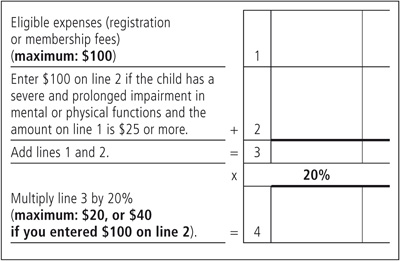
The tax credit is equal to 20% of the eligible expenses (registration or membership fees). The maximum amount of such expenses is $100 per child, for a maximum tax credit of $20 per child. If the child has a severe and prolonged impairment in mental or physical functions and the eligible expenses are $25 or more, you can add $100 to the amount of the expenses. Note, however, that the total of the two amounts (that is, $100 plus the amount of the eligible expenses) cannot exceed $200 per child, for a maximum tax credit of $40 per child.

Use the work chart below to calculate the amount of the tax credit to which you are entitled. Calculate a separate amount for each eligible child and then add the amounts for all the eligible children together. Carry the total to line 462 of your income tax return.  

Splitting the tax credit

If another person is also entitled to this tax credit for the same eligible child, the two of you can split the amount of the credit. While you can choose how to split the credit, the total amount claimed by both of you cannot exceed the amount to which you would have been entitled if only one of you were claiming the credit.

Expenses that are not considered eligible expenses

You cannot claim the tax credit for any of the following expenses:

  • fees paid for a program of activities offered by a person who, at the time of payment, was either your spouse or under 18 years of age;
  • fees for which anyone (you, your spouse or another person) received, or is entitled to receive, a reimbursement or any other form of assistance (with the exception of the non-refundable tax credit offered by the federal government), unless the reimbursement or assistance was included in that person's income and the reimbursement or assistance cannot be deducted elsewhere in that person's income tax return;
  • fees that were used to calculate another deduction or refundable or non-refundable tax credit claimed by you, your spouse or another person.
  • fees paid for an excellence in sport (Sport-Études) program.

Work chart

Monday, October 7, 2013

New Tuition Benefit: Tax-Free For Your Employees!

TAX LAW
BULLETIN
     
New Tuition Benefit: Tax-Free For Your Employees!
Despite challenging economic times, many corporations across Canada remain committed to advancing employee education through tuition reimbursement policies. These types of policies help companies to retain talent and lower the risk of attrition. Some companies also extend tuition assistance to their employees’ spouses and dependent children. This assistance ranges from full to partial reimbursement of private school or post-secondary tuition fees. The assisting company usually covers the cost of tuition only, while the employee or family member of the employee remains responsible for paying any non-instructional fees and purchasing books and other supplies.

Historically, the Canada Revenue Agency (the "CRA") treated tuition assistance for an employee's family member as a taxable benefit to the employee and required the company to attribute a fair market value (FMV) to this benefit. The CRA's position was successfully challenged in a recent court case, and is also overruled in certain circumstances by a legislative change to the Income Tax Act (Canada) enacted on June 26, 2013. The legislative amendment provides that if four specific conditions are met, free or discounted tuition for an employee's family member is not subject to tax in the hands of the employee. This means that if you provide the family members of your employees with free or reduced tuition assistance and the conditions for the application of the exemption are met, you will not need to include the amount of the assistance in the employee's T4 as taxable income. Instead, you will report the FMV of this benefit as a bursary on a T4A slip for the family member. If the family member in turn meets certain criteria, then this benefit might be excluded from tax altogether.

Monday, December 3, 2012

Giving up the Bank Kool-aid.


December 2, 2012 — Steve Garganis

Big six banksRecently, I’ve had several new clients contact me about getting out of their higher rate BANK mortgage… No surprise here… with interest rates reachingnew all-time lows, it only makes sense to look into this further…
But I’ve noticed a very familiar pattern developing….See if this sounds familiar:
1-First, you hear about these record low fixed rates… maybe online, from a friend, or from one of my current clients…
2- You contact your Bank to see what they can do…
3-Your Banker gives you 2 options… 1- pay an inflated prepayment penalty (BIG SIX BANKS make you pay for any rate discount) and get into a new 5 yr fixed rate of 3.29% (this is the best advertised rate today by a BIG SIX BANK).  OR 2- they’ll blend the penalty into a new mortgage but your rate will be higher… (this never works to your advantage.. there is NO assurance the Bank will offer you the absolute best discounted rate when calculating your new rate.. it’s been a favorite tactic of the Banks for decades…don’t drink this kool-aid… it will cost you $$thousands). 
Most of us will stop right there and go no further…We’ve consumed so much Bank kool-aid that it’s turned us into a flock of sheep… But if you’ve started to become immune to the Bank tactics and want to explore further, then read on…
4- You call a Mortgage Broker, maybe me… you discover that today’s best 5 yr fixed rate is under 3.00%…   (That’s today’s best 5 year wholesale mortgage rate with NO ADDITIONAL RESTRICTIONS OR LIMITATIONS…It’s important to understand this fine point.)  And you discover it’s now worth paying the penalty to get into this new mortgage.
5- Everything is going great… but come payout time, your Banker contacts you… They make a last-minute plea to save your business… Somehow, they miraculously offer to match the Broker rate…
Every heard of this before?  What would you do?
Most of my clients, that go through this process, quickly discover who has their best interests at heart.  They realize it’s better to deal with ‘rate-setters’ vs ‘rate-matchers’.    But oddly enough, I have seen some clients stick with their Bank… Like other addicts, they can’t seem to explain it..   Even after going through the entire mortgage review and approval process (or what I refer to as the  Bank detox process).   When asked why they stayed, they couldn’t give any logical reason.  They just keep going back to the Bank for another fix.
10 years ago, this happened more often.  But times have changed.  Kool-aid is out.  Protein shakes and Red Bull are in.  Today’s consumer is more educated… information flows faster.  Even the Bank of Canada said “borrowers who use a mortgage broker pay less, on average, than borrowers who negotiate with lenders directly”. (February 2011 entitled ‘Competition in the Canadian Mortgage Market’’).
As always, if you have any questions or comments or are just looking for a better mortgage, please free to contact me anytime.

Wednesday, November 14, 2012

Debt Management Plan – Pros, Cons and Options


Continuing in our Debt Management Series, we now have a better understanding of what a debt management plan is.  Today we will talk more about debt management plan pros and cons and what other options you may have.
Deciding if a debt management plan, or any other debt relief option, is right for you requires a careful consideration of your individual situation.  Make a list of your debts, how much you owe and how much you think you can afford to pay each month.  With that information in mind, consider these advantages and disadvantages of a Debt Management Plan (DMP).

Debt Management Plan advantages

  • A DMP is an informal arrangement with your creditors that allows you to avoid bankruptcy or other insolvency proceedings.
  • You make one lump sum payment to your not-for-profit credit counselling service agency and the monthly payment is usually less than you are paying now.
  • Creditors may freeze or waive interest payments reducing the total amount you will have to repay.  Often they will only agree to waive interest at the end of the plan assuming you have made all of your monthly payments on time.
  • A DMP may have less of an impact on your credit score (assuming you make your payments regularly) although a note is usually placed on your credit report stating that you are paying your account through a debt management plan.
  • If you choose your credit counsellor carefully, you will be able to take advantage of budgeting and credit management education to help you manage your finances better once your DMP is complete.

Debt Management Plan disadvantages

  • A DMP is an informal arrangement.  Creditor participation is entirely voluntary and they can change their mind.
  • It will not stop wage garnishments and other court proceedings.
  • You will need to pay back 100% of your debt plus an administration fee and likely some interest.
  • You will not likely be able to obtain new credit while enrolled in your debt management plan as a condition for reducing or waiving interest.
  • You will need to be sure you make all of your monthly payments.  If you are late you will potentially invalidate your agreement with your creditors and may lose out on any negotiated benefits including lower interest.
  • Missed payments under a debt management plan will affect your credit score and will likely remain on your credit report for up to 7 years.
  • You must do a lot of research to find a reputable and reliable credit counselling agency to administer your debt management plan.  You should beware of debt settlement companieswho offer too good to be true settlement programs.
If based on your personal situation and a review of these debt management plan pros and cons you feel that you are not able to pay back all of your debts, are dealing with the potential for a wage garnishment or may not be able to make all of your payments as suggested by your credit counsellor you may want to consider making a consumer proposal. Consumer proposals are a formal action under the Bankruptcy and Insolvency Act, administered by a Consumer Proposal Administrator. There are several differences between a consumer proposal and a debt management plan that may provide a better debt relief option for you.
The post Debt Management Plan – Pros, Cons and Options appeared first on Money Solutions Blog.

Thursday, November 8, 2012

Fewer Canadians missing loan payments but high debt still a concern


Fewer Canadians are missing or defaulting on loan payments according to a report from Equifax Canada.  This despite the fact that the average debt balance owed by Canadians continues to grow.
The number of Canadians missing loan payments fell to 1.22% in the third quarter 2012, the lowest level since before the recession.  This would seem like goods news except for the fact that Canadian debt levels continue to rise.  The Equifax report also reveals that non-mortgage consumer debt increased by 2.6%.  And according to Statistics Canada consumer credit continues to expand, increasing by 2.7% in August over the same month in 2011.
Nadim Abdo, Vice President, Consulting Solutions, Equifax Canada says seeing “serious delinquencies drop to a record low of 1.22 per cent is a very positive sign that consumers are doing a great job at managing their debt obligations”.
What the drop really says is that Canadians are managing to meet their monthly loan payments – not that they are managing their overall debt. Consumer debt levels have continued to burgeon in Canada with the debt-to-income ratio reaching a record 163% in the most recent quarter.
The main reason more Canadians are, for now, not missing more loan payments is because interest rates are at historical lows. The question becomes how will Canadians with too much debt be able to cope when interest rates increase? Will interest rate increases cause more Canadians to have to file bankruptcy in the long run because they are not reducing their total debt levels fast enough?
In the report Mr Adbo also states that “Debt is increasing at a slower rate, the actual delinquencies are improving, they’re going down. That to me actually shows responsibility of some sort.”  Mr Adbo adds “You could actually argue that people are paying off at least a bit of their credit card debt now.”
If your debt is growing, it’s growing.  Growing at a slower rate on a much larger number is still something to be concerned about.  Eliminating high interest credit card debt is only the first step in managing debt. Shifting debt from one form to another is not a long term debt solution. The overall objective should still be to reduce your debt in total.
So while the Equifax report gives some hope that Canadians are, for the moment, able to meet their loan payments, these findings unfortunately are just an interest rate hike or unemployment rate increase away from reversing.  And at the moment, the risk of either of those events happening in the near term remains high.
The post Fewer Canadians missing loan payments but high debt still a concern appeared first on Money Solutions Blog.